A Fed Hike Is Now 80% Certain. Nine Sectors Already Paid for It.
Market Recap · September 13th 2026 · The Philosopher Investor
2026-09-13 · 11 min read · Originally published on Substack ↗
Hello my friends,
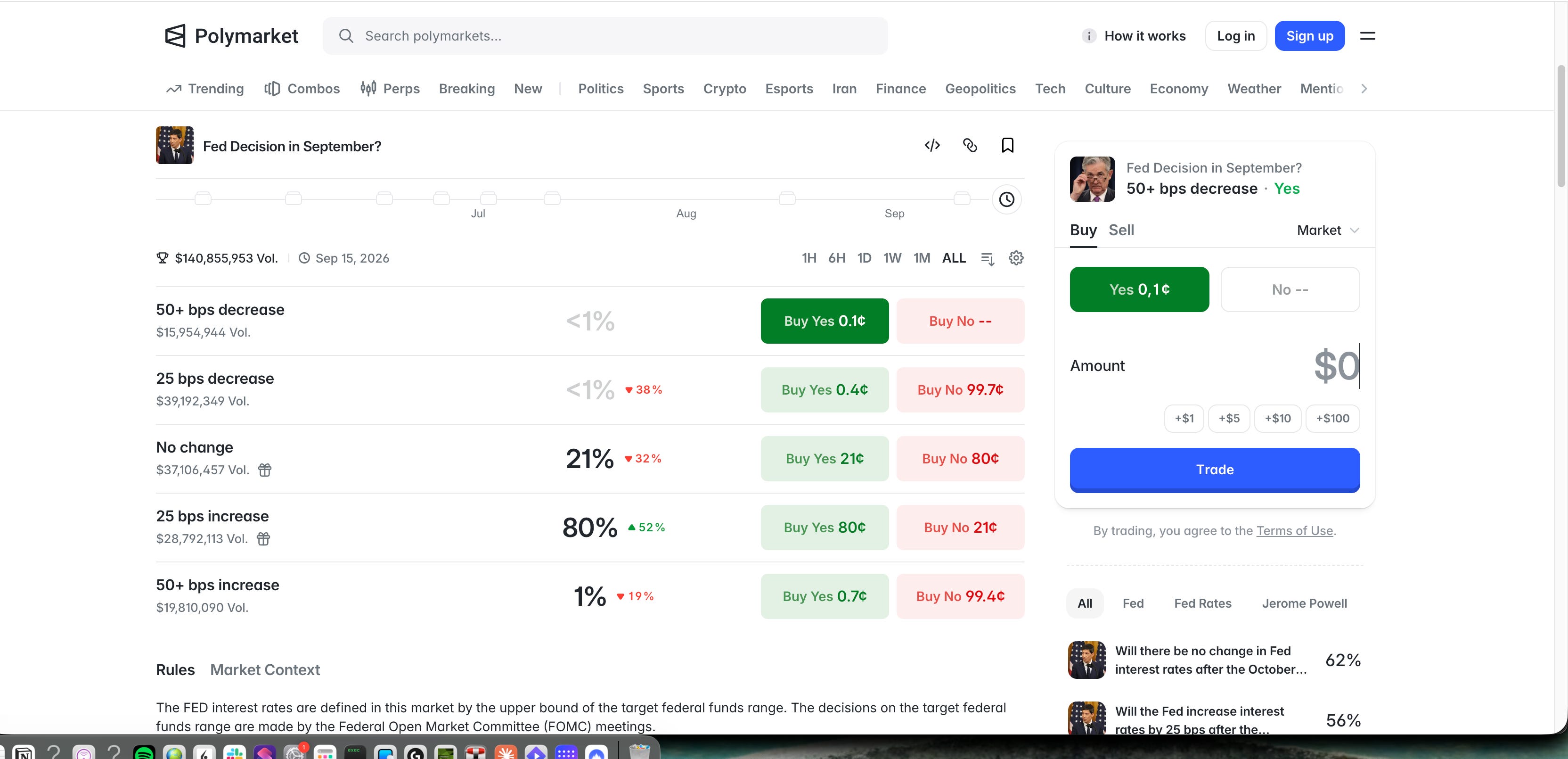
Core CPI came in hot on Friday September 11 and a hike at Wednesday’s Fed meeting went from a coin flip to 80%. (on polymarket)
The S&P 500 lost less than 1%. The equal-weight version of the same index lost 1.9%, nine of eleven sectors trade below their trend, and oil is back above $100.
At Friday’s low, put buyers came in size and paid close to nothing for protection. That combination, quiet cap-weighted index and cheap insurance under heavy demand, is the tension going into Wednesday’s Fed decision.

Get the app.
Every subscriber gets this letter.
Paid readers also get the app it is written on, free for 7 days to start.
What is inside:
Twenty-six screeners. They run every night on 12,000+ US stocks: pullbacks, breakouts, bottoms, squeezes, insider clusters, unusual options flow.
Sectors and themes. Which corners of the market lead and which lag against the S&P, which way each one is turning, and twenty-six themes tracked basket by basket: AI agents, defense tech, drones, critical minerals, the power grid, fintech.
Where the market stands. Breadth, rates and inflation, the dollar and the curve, commodities, crypto, and the sentiment gauges, all rebuilt after every close.
Who is buying. 13F books from 100+ funds, activist stakes, Congress disclosures, insider clusters, buybacks, federal contracts.
Your desk. Build your watchlist, set your price alerts, analyze your positions, keep your trading journal, and size your next trade.
The Academy, our private trading course. 35 lessons that take you from reading a chart to sizing a trade and a guide to every page in the app.
📊 Market Health
The hike is already in the price of most stocks. It is not yet in the price of the index.
A rate hike hits the borrowers first. That means the middle of the S&P 500, the companies with floating debt and a refinancing due next year. The ten largest names carry no net debt and fund themselves. So when the 2-year yield jumps to 4.63% in a week, the typical member reprices and the index barely moves.
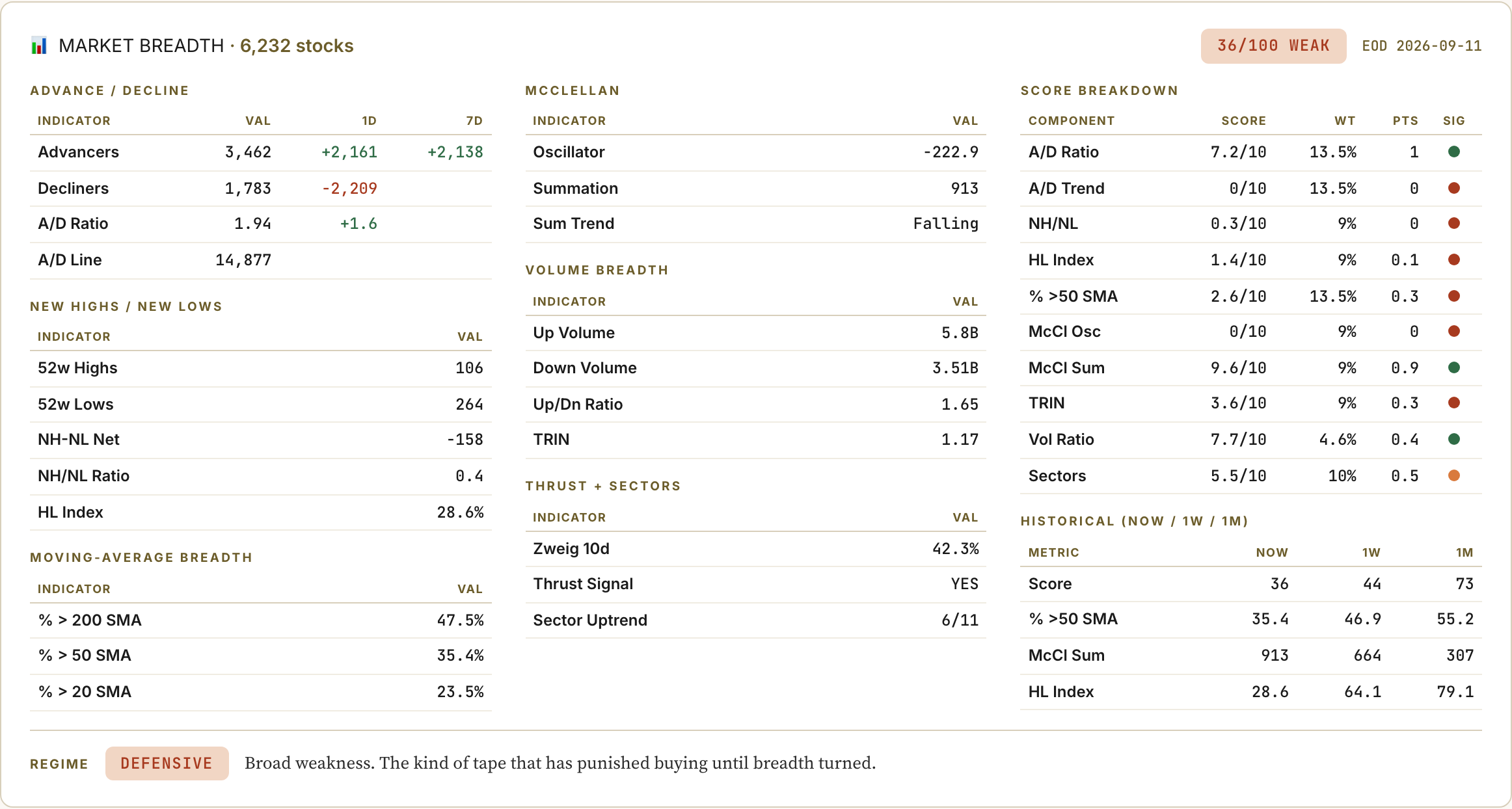
My health score fell to 24 on Thursday and closed at 36, while the cap-weighted S&P sits 1.8% from its record. Only 35% of stocks hold above their 50-day average. At the July low that gauge sat near 41% with the index close to 5% lower, which means the members are weaker today than at the July bottom while the index trades at the top. One of those two prices is wrong.
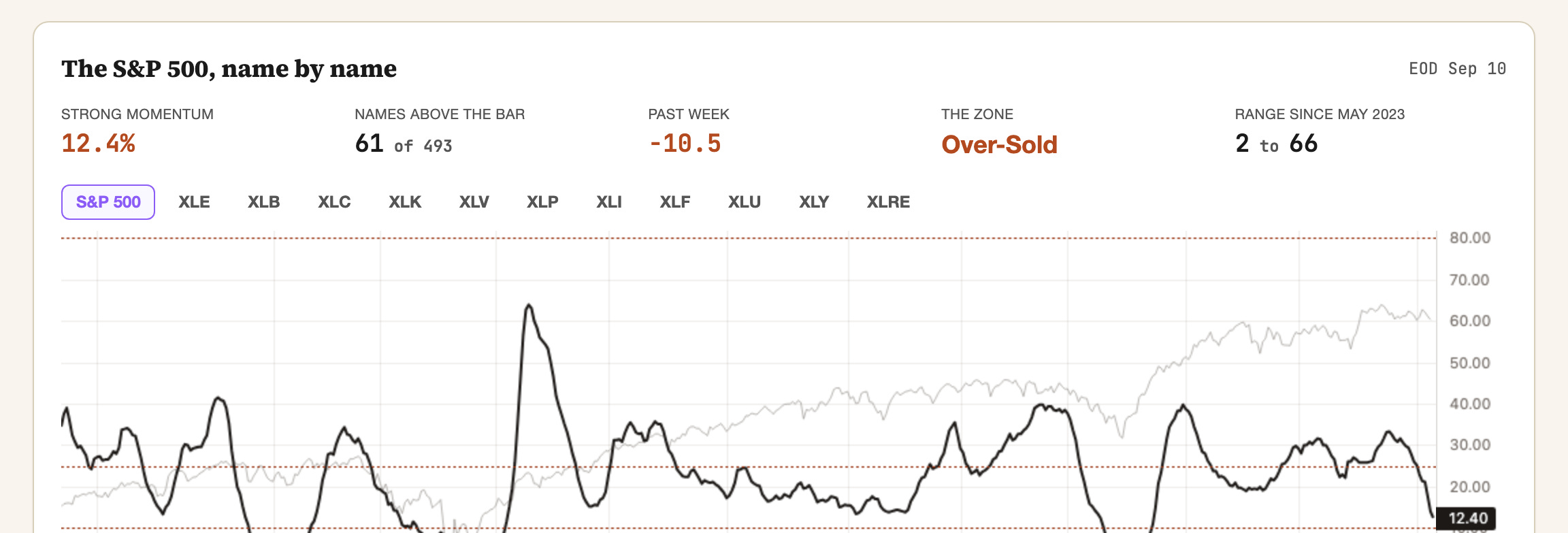
The momentum count adds a precedent. Only 61 of the S&P names, 12.4%, still carry strong 30-day momentum.
Which is how to read Friday. Three down sessions, core CPI at 0.3% against 0.2 expected, then 3,462 advancers against 1,783 decliners. That looks like a turn until you ask who was buying: the same people who had sold the outcome all week. A rally on bad news is a short cover, and a short cover says the market was positioned for this. It does not say the selling is done.
“While this summer’s PCE and CPI readings were better than expected, they do not tell me that underlying trends have meaningfully improved.” Kevin Warsh, Jackson Hole, August 28.
A chairman who did not trust the good readings has now been handed a bad one. What ends the correction under the surface is one thing I can measure: the equal-weight S&P beating the cap-weighted one three sessions in a row, because that is what money coming back to the members looks like.
🚨 Sector Rotation
Only energy is being bought. Everything else is being sold in the order a hike hurts it.
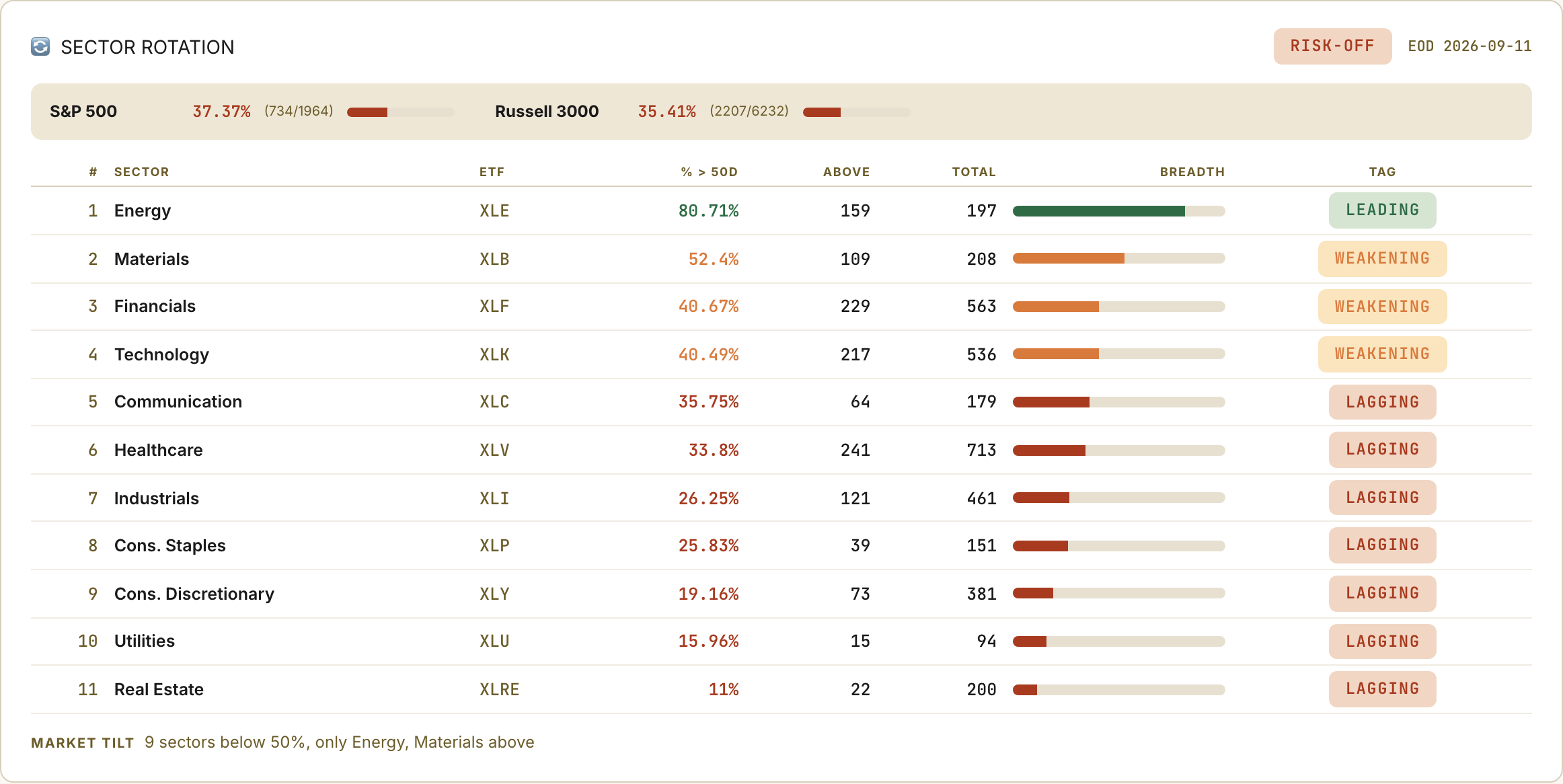
Two sectors hold a majority of their members above trend, down from nine in mid-August, and only energy went up: 81% of its names in uptrends while WTI closed above $100 for the first time since May. Energy is a bet on a strait that stays shut, and that bet does not care what the Fed does on Wednesday. That is why it leads a week when everything priced off the curve falls.
Inside it, refiners are the strongest industry I track, 52 points ahead of the S&P over sixty days. They buy crude that has trouble reaching the market and sell fuel that everyone still buys. The gap stays open as long as Hormuz does not, which makes it the one place a long book can hide from the meeting, and a poor foundation for an index recovery.
And on Friday the second door started to close. The Houthis took Mokha, the island of Perim and the rest of Yemen's Red Sea coast, which puts them on both sides of Bab el-Mandeb, the strait Saudi Arabia has been using to ship crude since Hormuz shut. The same day Riyadh closed its East-West pipeline, the line that carries that crude to the Red Sea, after strikes along its route. If the Gulf's crude cannot leave by the east and now struggles to leave by the west, the crack spread does not normalize next year, it widens, and every refiner outside the region earns it.
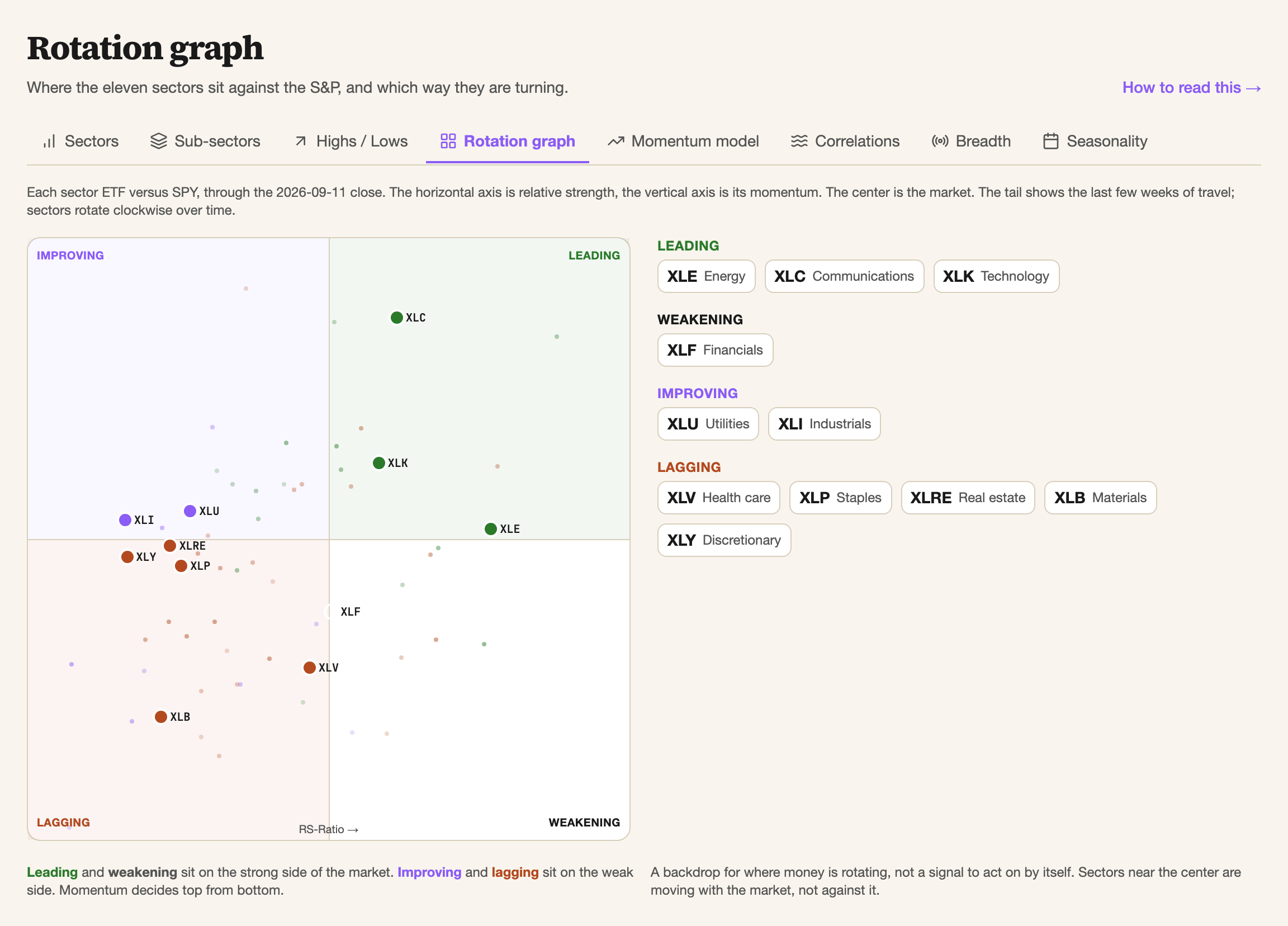
Real estate last, utilities next, the two groups priced off a 10-year that went to 4.97%. Then financials, which left the leading quadrant because a hike into a flat curve is the one rate move a bank cannot earn on. Then health care, down 3.6%, the worst line on the table, even though people buy it for safety. When the safe sector trades like a cyclical, the selling is about the price of money, not about growth.
Technology is what remains, with 40% of its members above trend and enough weight to replace energy. So the index stands on a sector where six names in ten are in a downtrend, and holds because Nvidia, Microsoft and Apple hold. The day one of the three cracks, there is no second sector behind it. That, more than breadth, is the risk into Wednesday that a VIX at 15.8 does not price.
📉 Volatility
The options market is hedged in the right places, and it paid a discount for the hedge.
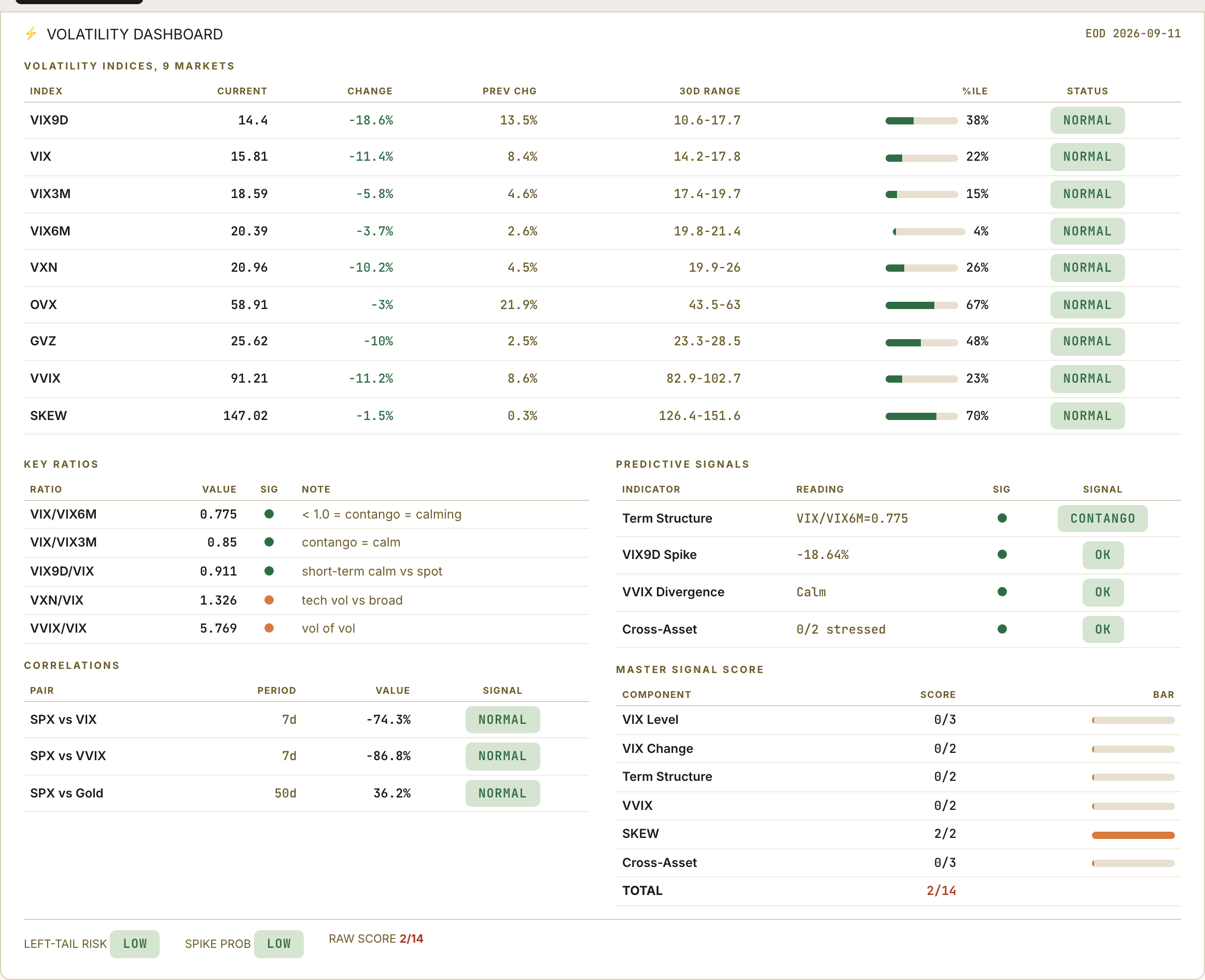
The VIX at 15.8 says calm. VIX3M/VIX at 1.18 says three-month protection costs more than one-month, the normal shape of a market that expects no shock. The SKEW, the price of crash protection, fell to 147 from 151.6 a week ago. Into the most important Fed meeting of the year, the crash hedge got cheaper.
That is not because nobody hedged. The put-call ratio on single stocks went from 0.69 a week ago to 0.875 on Thursday, the top 10% of the year. In four sessions the options market went from buying calls at the high to buying puts at the low, and where the puts went says what it fears: 16 puts for every call on financials, $11.3 million of it in a single October contract, the 56 puts, 3.4 per call on semiconductors, 2.2 on small caps, 2.1 on health care. Banks, chips, small caps, health care. That is a list of what a hike hurts, hedged in advance.
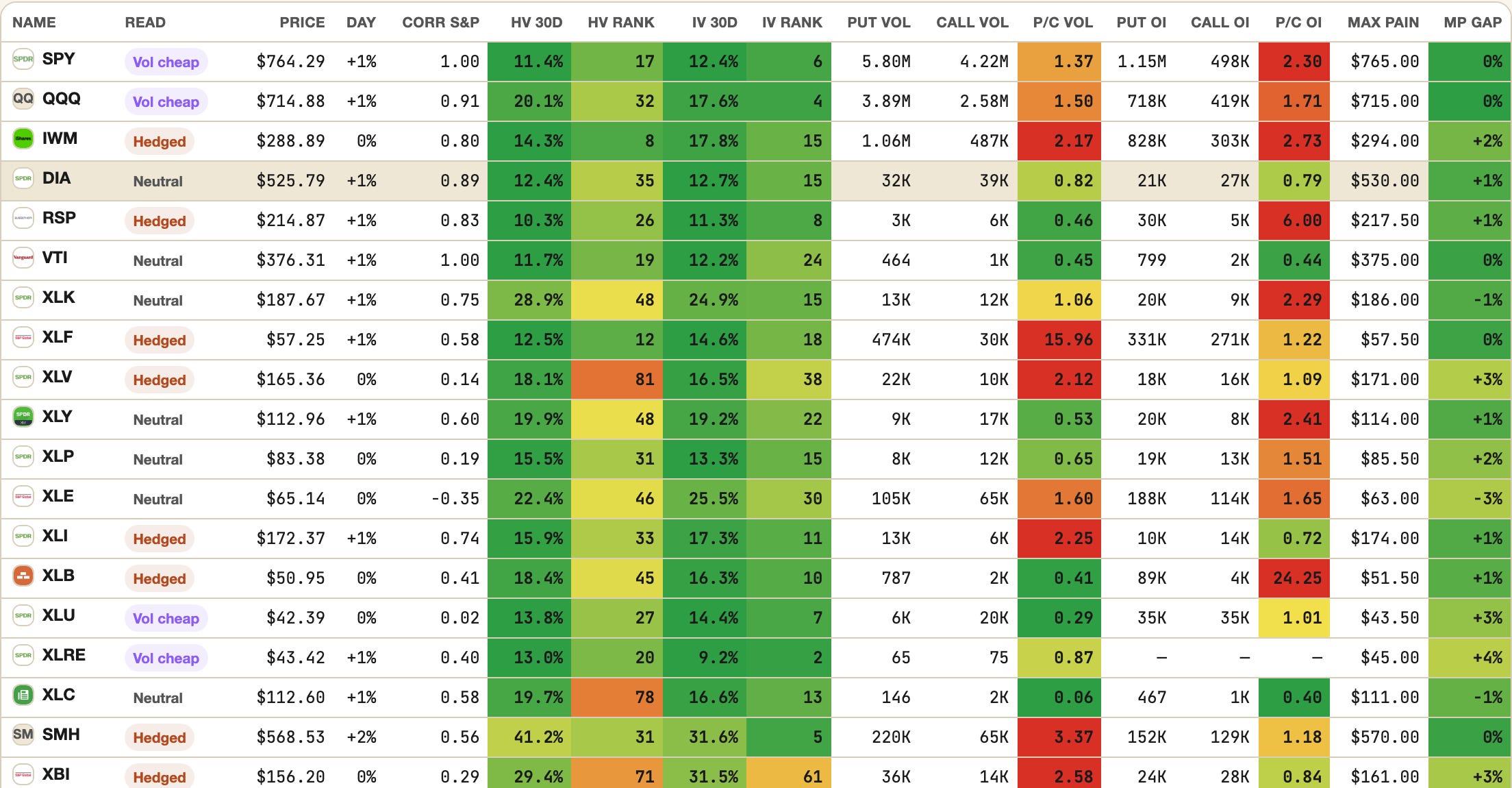
The hedge was cheap because implied volatility sits in the bottom 10% of its year on 206 of the 2,106 names I track, SPY included. The Nasdaq-100 moved at a 20.1% annualized pace over the past month and its options price 17.6% for the next one. The market is paying less for protection than the index has been moving, in the week the Fed decides.
Two prices cannot both be right, puts everywhere and volatility nowhere. Where it resolves is a level: dealers who sold that cheap protection dampen every move between 770 and 745 on SPY, and below 745 they have to sell stock to stay hedged, so the decline feeds itself and a 3% range becomes a 10% one.
💱 FX
US yields jumped and the dollar did not follow. That is the tell that something else is moving.
The 2-year went from 4.39% to 4.63% in a week and the dollar index closed flat near 99. Higher yields should pull money into dollars. The money went to the yen instead: dollar-yen fell to 153.55 from 156.25, the yen’s second straight week of gains and the strongest currency of the week.
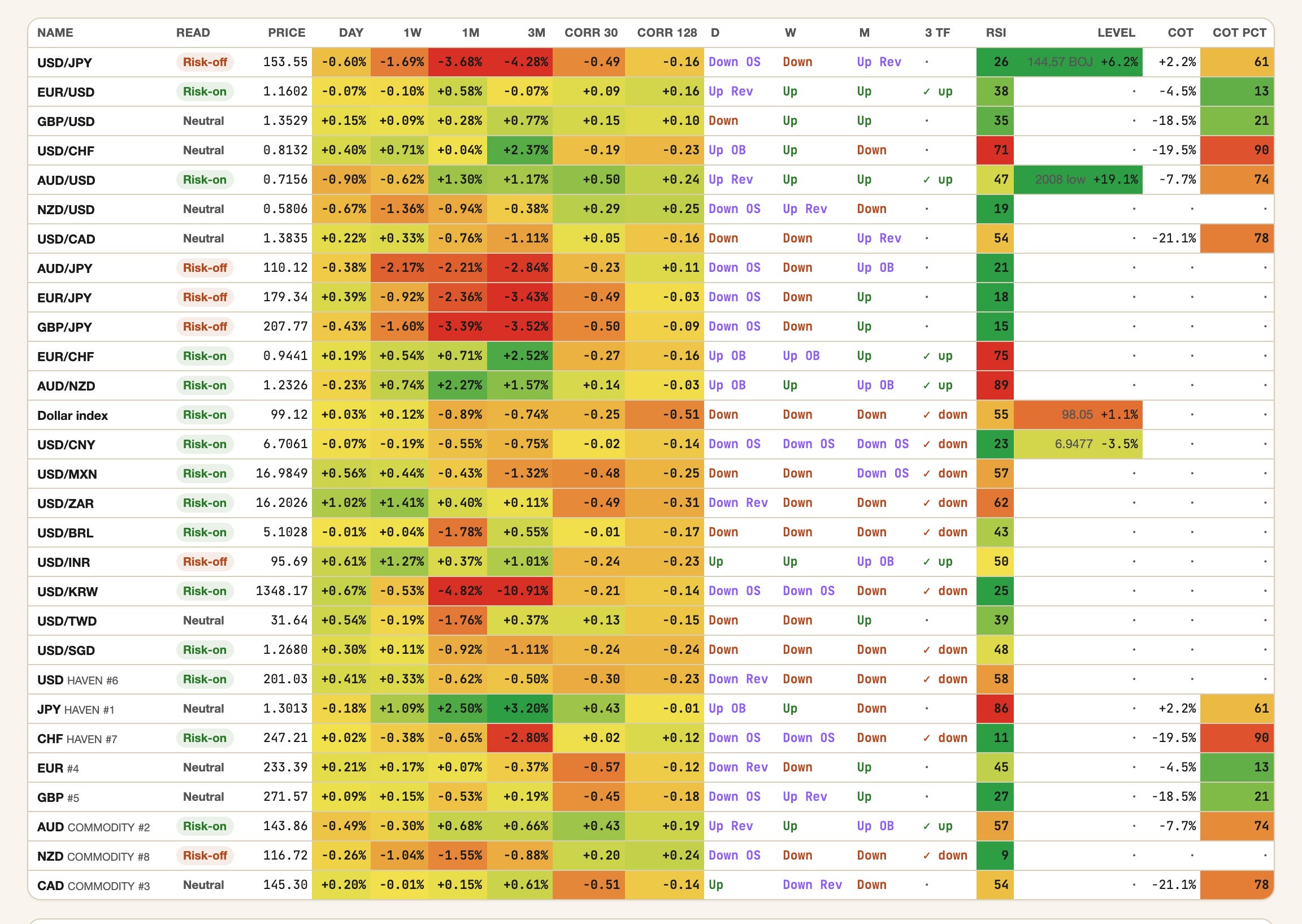
The reason is a date. The Bank of Japan meets on September 17 and 18, the day after the Fed, and traders expect a hike there too. Two central banks raising rates in 48 hours means the cheapest funding currency in the world gets more expensive at the same moment as the dollar, and every trade funded in yen gets unwound at once. The last time a yen rally met a Bank of Japan hike was July 2024, and the S&P lost more than 8% in three weeks.
Positioning is smaller now and the Bank has already moved twice, so I do not expect a repeat. But the funding currency of the carry trade is 3% more expensive than three weeks ago.
💡 Trade Ideas
1. $PBF, the refiner
Refiners make money on one thing: the gap between what they pay for crude and what they sell gasoline and diesel for. That gap is usually $15 to $25 a barrel. In August it was near $69, because the Gulf’s crude cannot get out. PBF owns six refineries and the pipelines that feed them, so almost all of it drops to earnings. Last quarter it made $6.22 a share when analysts expected $3.49.
Analysts still have a target of $67.62 on it, under Friday’s close of $78.30. Their
targets have not caught up with a quarter that beat them by 78%. After what the Houthis did on Friday, I think the gap gets wider before it gets narrower.
The chart is the reason I am not buying Monday. Friday ran to $82.61 and closed at $78.30, a big wick on top. Somebody sold that spike hard, and one of the sellers was the Slim family, $24.8 million worth over two days. That is a reversal candle, so I want the pullback, not the breakout.
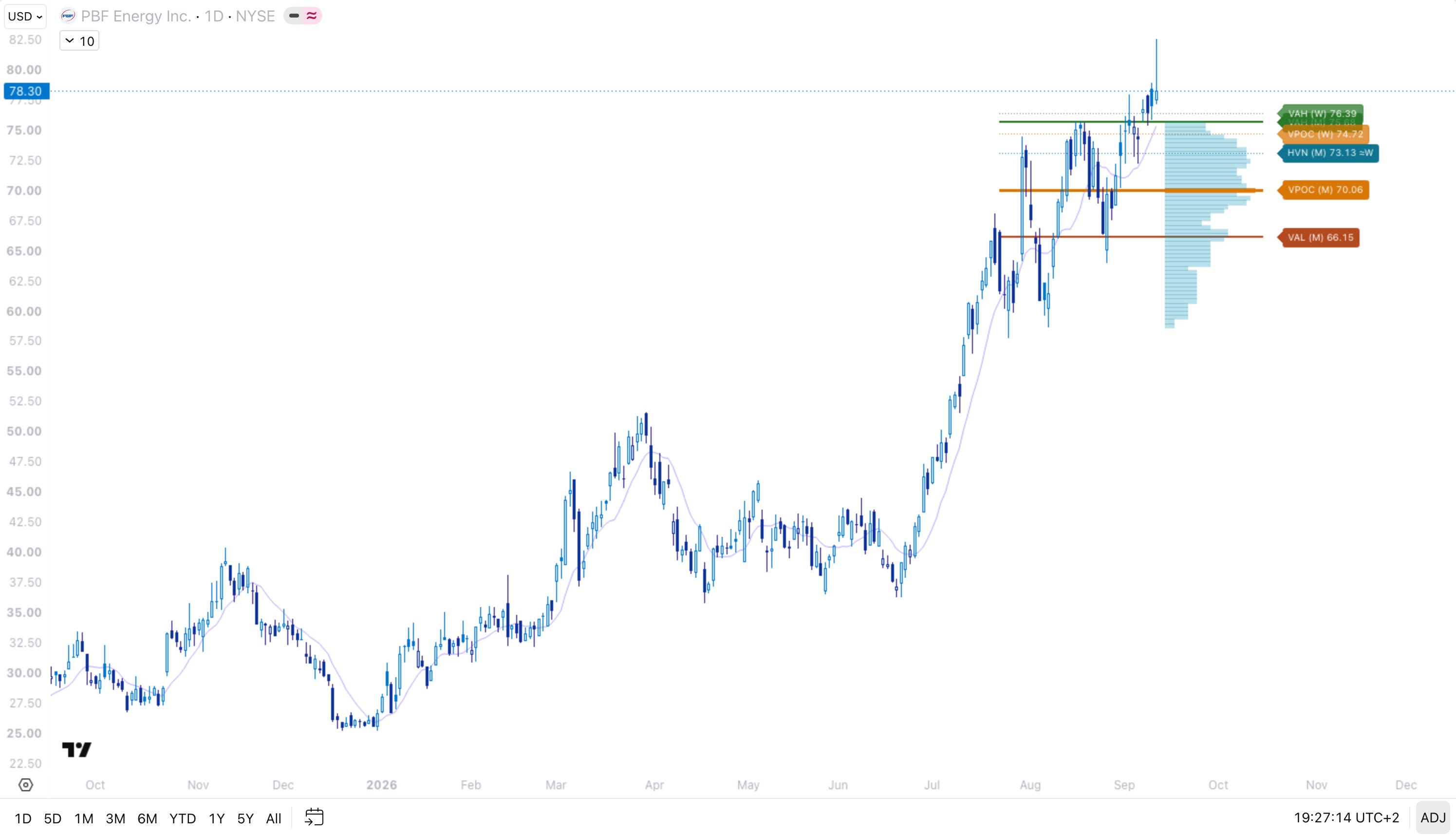
There are three levels on the way down, and I want a piece at each. Last week’s ceiling at $76.39, where the stock spent most of last week deciding. The month’s high-volume node at $73.13, a dense zone where price slows down rather than passes through. And the month’s busiest price at $70, the orange line, where most of this month’s shares changed hands. A third at each, average price around $73.30.
One caveat on the last third. A stock that falls back to $70 after a week like this one is telling me the spread story is fading, so I only take that piece if Hormuz is still shut when it gets there. Under $66 is the bottom of where the shares changed hands this month, and the volume below it is thin because July’s rise was vertical, which means a break there will not be orderly. A close under $66 and I am out, whatever the news. First target is the high at $82.60. Second target is the height of this month’s value, about $12, added to its top: $90. A Hormuz ceasefire kills the spread in a day, so half my usual size.
Sizing: half the usual, in three thirds
Entry: $76.40, $73.10, $70.50
Stop: a close under $66
Target 1: $82.60 · Target 2: $90
2. $MU, memory chips
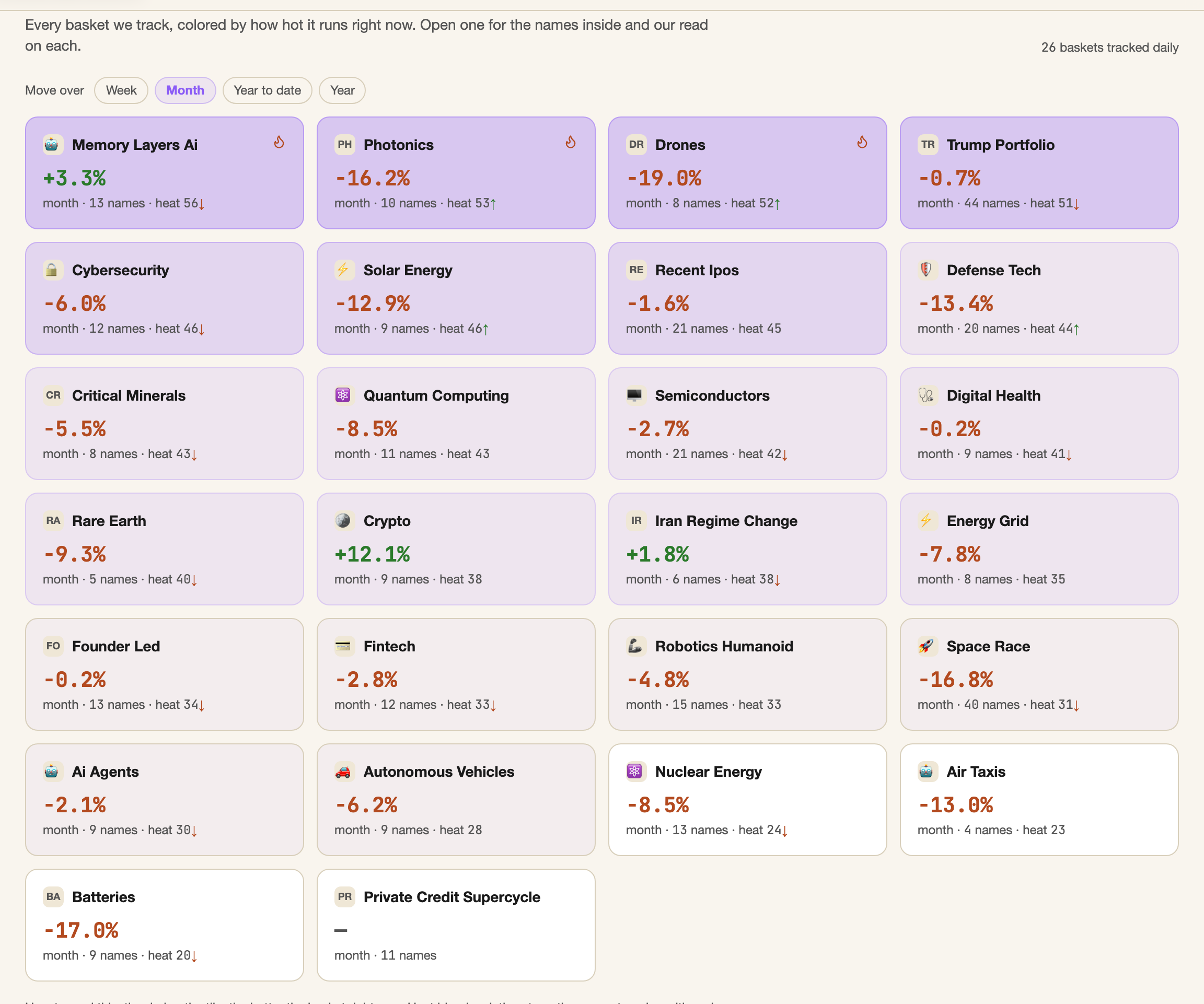
Memory is the only AI basket on my themes page that went up this month, +3.3%, and it was the strongest on the week at +6.8%, while drones, batteries and photonics all lost 16% to 19%.
The reason is simple. Amazon raised its 2026 spending last month to $220 billion from $200 billion, and its CEO said the extra $20 billion is the price of memory going up.
“The higher cost of memory is pushing this number up from our prior estimate of about $200 billion. Even at that amount, we will not have enough capacity to meet all the demand we have in 2026, and I believe this dynamic will also be true in 2027.” Andy Jassy, Amazon’s second-quarter call.
When your biggest customer says your product got expensive and he is buying more anyway, that is the trade. Micron sells the product. Two things to know: it reports around September 21 and chips as a group are weak right now, so this is a leader in a bad sector.
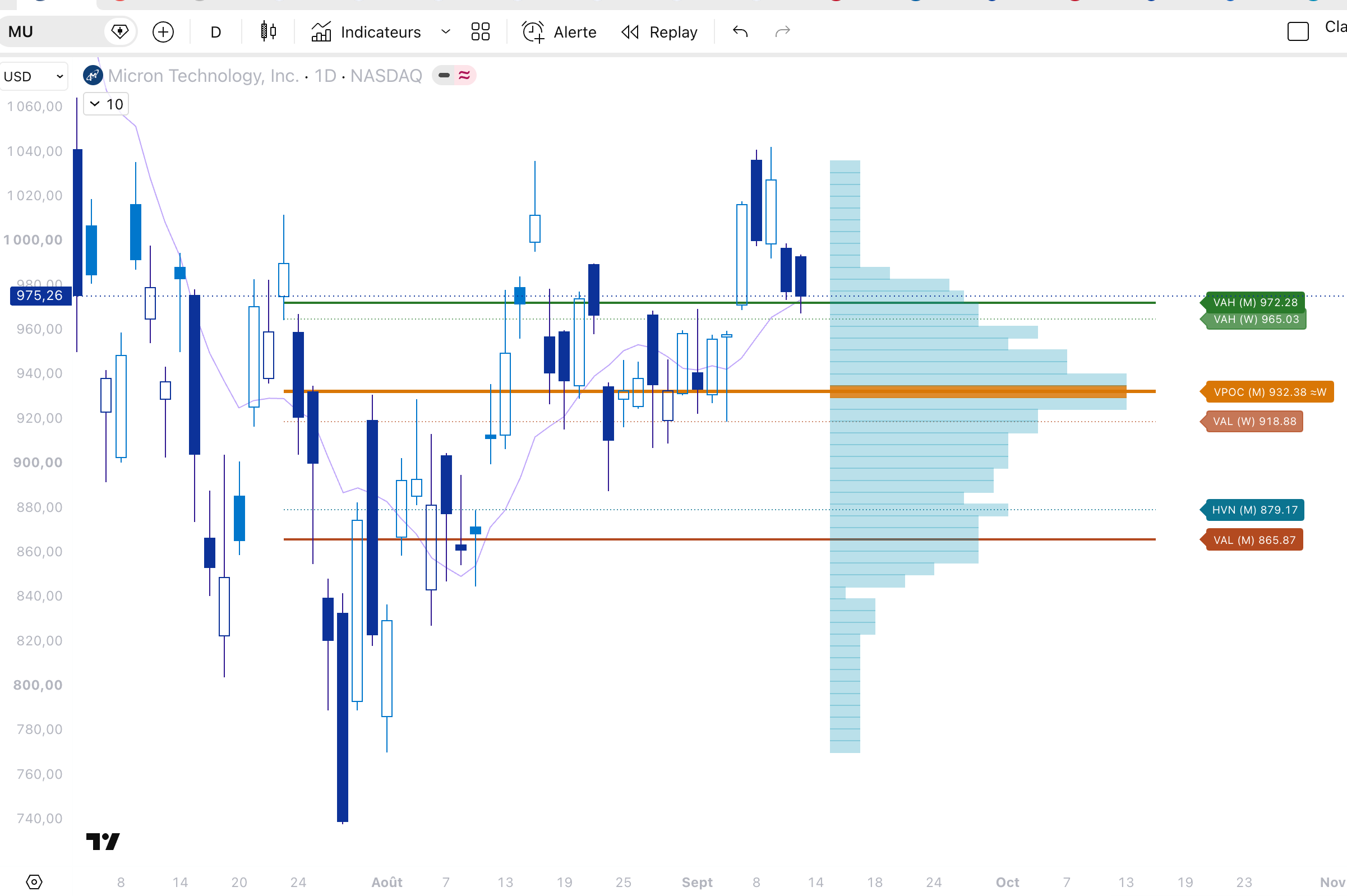
Micron closed at $975. Most of last week’s shares traded between $919 and $965, with the busiest price at $932. So the stock is sitting just above where everyone bought it this month. I buy the dip back into that zone: half at $965, half at $932. Under $876, the last place buyers showed up before the August low, I am out. Targets are the September 9 high at $1,042 and then $1,214. Half the size before the report, half after, because a chip stock can gap either way on earnings.
Sizing: half the usual, one half before the report, one half after
Entry: $965 first half, $932 second half
Stop: $876
Target 1: $1,042 · Target 2: $1,214
3. $GDX, gold miners
Gold has gone down three weeks in a row. The miners have not: 90% of them are still above their 50-day average. When the miners hold while the metal drops, the market is saying the drop is a shakeout, not a new trend.
On Friday, $3 million of GDX calls were bought, struck at $101, expiring September 18. That is two days after the Fed. Whoever bought them is betting the Fed sounds like it is done hiking, real yields come down, and gold rips. Calls outran puts seven to three on the day.
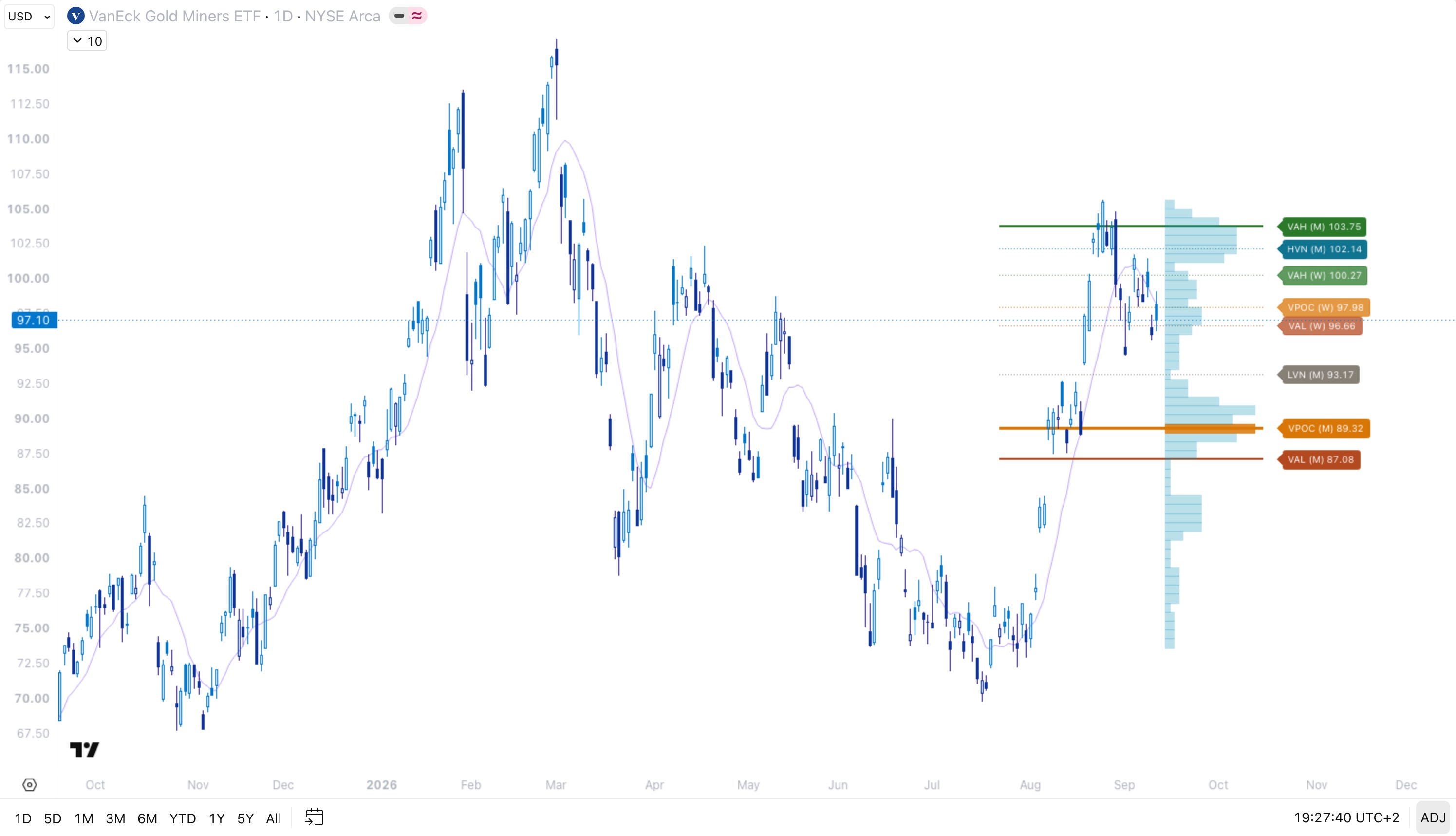
GDX closed at $97.10, right at the bottom of where it traded last week, $96.66 to $100.27. This month’s busiest price is $101.66, which is why the calls are struck at 101. Below $96.66 there is almost no volume until $89.32, so if it breaks, it breaks fast.
I buy a first half at $96.70 and the second half only if it drops to $89.50. Under $87, the bottom of this month’s value on the chart, the August breakout failed and I am out. Targets are $101, then $104, then the old high at $117. If the Fed sounds hawkish on Wednesday, this one loses, so it is small.
Sizing: a third of the usual
Entry: $96.70 first half, $89.50 second half
Stop: $86.90
Target 1: $101 · Target 2: $104 · Stretch: $117
See you next week,
Daniel
Disclaimer
This newsletter is for educational and informational purposes only. It is not financial advice.
The content reflects personal opinions shared publicly as a journal. Trading stocks, options, futures, or any financial instrument involves significant risk. You can lose your entire investment. There is no guarantee of profit.
The author is not a registered investment advisor, broker, or financial professional with any regulatory authority including the SEC or CFTC. Always consult a licensed financial advisor before making any investment decisions.
By reading this newsletter, you accept full responsibility for your own trading and investment choices. Past performance does not guarantee future results. Markets are unpredictable.
Screenshots are courtesy of TradingView, VixCentral, and other platforms with which the author has no affiliation. Information shared may contain errors or become outdated quickly.
This content is the intellectual property of the author. Copying or redistributing without permission is prohibited.
By continuing to read, you acknowledge and accept these terms.
Tickers in this edition, with their free data pages: MU
Read the desk every week
Market analysis in plain English, plus the app that scans the whole US market for you.
Become a member Read the original on Substack ↗